The Case for Tailoring: How Small Adjustments Transform What You Already Own
There is a particular frustration familiar to almost every adult American shopper: a garment that is nearly right. The shoulders sit correctly. The color is flattering. The fabric has weight and substance. But something—a waist that runs too wide, a hem that falls at the wrong point on the leg, a sleeve that extends past the wrist by an inch too many—keeps it from working. Most of the time, that garment gets returned, donated, or pushed to the back of a closet.
That response, while understandable, represents a significant missed opportunity. The alterations required to correct most common fit problems are modest in scope, relatively low in cost, and transformative in effect. What separates a wardrobe that functions beautifully from one that merely exists in a closet is often not the quality of the garments themselves, but whether they have been adjusted to fit the specific body wearing them.
Why Ready-to-Wear Fit Is Structurally Imperfect
Understanding why tailoring matters begins with understanding why off-the-rack clothing fits the way it does. Apparel manufacturers, including those producing at the higher end of the market, construct garments according to standardized size specifications derived from averaged body measurements. Those averages are useful for production efficiency, but they describe a statistical composite—not any particular individual.
The result is that virtually no one fits a standard size perfectly across all dimensions simultaneously. A person whose shoulders correspond to a size 10 may find that the same garment's waist runs two sizes too large. A man whose chest measurement aligns with a 42 Regular may carry more height in the torso than the pattern anticipates, causing the jacket's button stance to sit lower than intended.
This is not a failure of the manufacturing process. It is an inherent limitation of producing clothing at scale. The appropriate response is not to search indefinitely for a garment that fits without intervention—it is to understand which adjustments are feasible and to factor their cost into purchasing decisions from the outset.
The Alterations That Deliver the Highest Return
Not all alterations are created equal. Some are structurally simple and dramatically impactful. Others are technically complex and may cost more than the garment warrants. Knowing the difference allows for smarter decisions about when to alter and when to walk away.
Hemming trousers and skirts sits at the top of the high-value, low-complexity category. The hem length on trousers directly affects how the entire garment reads—a break that is too generous makes legs appear shorter and the silhouette heavier. A clean hem at the correct length costs between $15 and $30 at most tailors and changes the visual effect of the garment entirely.
Taking in the waist on trousers or skirts is similarly impactful. A waistband that gaps at the back or a trouser seat that sags creates a silhouette that no amount of styling can fully correct. This alteration typically runs $20 to $40 and addresses one of the most common fit failures in women's and men's bottoms alike.
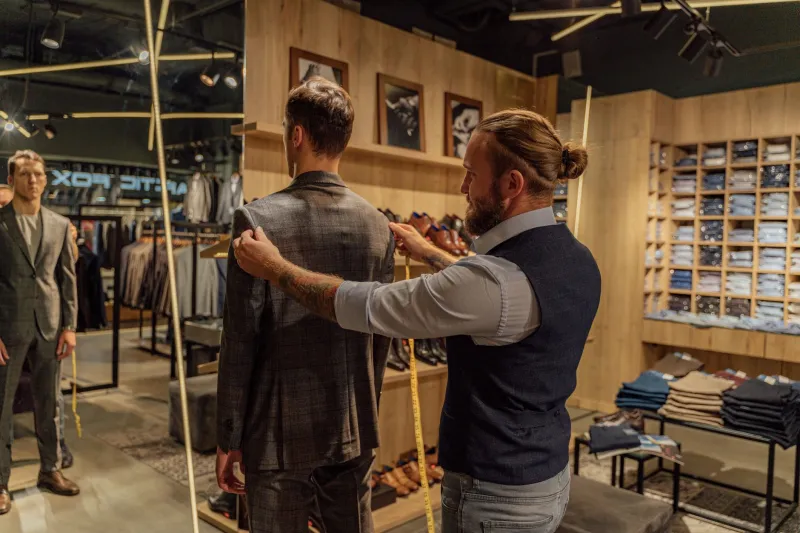
Shortening jacket or blazer sleeves is more complex when surgeon's cuffs—functional buttonholes—are involved, but it remains one of the most visible fit improvements available. Jacket sleeves that extend past the wrist bone interrupt the visual line of the arm and conceal shirt cuff detail. Correcting this single measurement can make an existing blazer appear custom-made.
Taking in side seams on shirts and blouses addresses the excess fabric that causes shirts to billow and pouch, particularly in the lower torso. This alteration requires a tailor with experience in garment construction, as improper execution can distort the collar or armhole. When done well, however, it converts a shirt that reads as sloppy into one that reads as intentional.
Tailoring as a Sustainability Practice
The environmental argument for tailoring deserves direct acknowledgment. The American apparel industry generates substantial waste, much of it driven by the cycle of purchasing, discarding, and repurchasing garments that never quite worked. Extending the functional life of existing clothing through alteration is one of the most concrete individual responses available to consumers concerned about that cycle.
A well-constructed garment that fits properly is also a garment that gets worn. Usage frequency is the most honest measure of a piece's actual value—a $400 coat worn twice generates a worse cost-per-wear ratio than a $120 coat worn forty times. Tailoring is the mechanism that converts garments from theoretical assets into actual wardrobe workhorses.
At Yuliwg Garment, our production philosophy has always centered on constructing pieces with sufficient seam allowances and material integrity to support alteration. A garment built with narrow seam allowances and minimal hem depth cannot be meaningfully adjusted. One built with proper construction standards can be adapted across a reasonable range of sizes and proportions, extending its relevance well beyond its initial purchase context.
Finding the Right Tailor and Setting Realistic Expectations
The quality of an alteration is entirely dependent on the skill of the person executing it. Dry cleaners that offer basic hemming as an add-on service are appropriate for straightforward length adjustments. For structural work—resizing a jacket, repositioning a collar, reconstructing a waistband—a dedicated tailor or seamstress with demonstrable experience in the specific garment category is worth the additional cost and effort to locate.
When evaluating a tailor, ask to see examples of comparable work, specifically asking about the garment types most relevant to your needs. A tailor who specializes in bridal alterations may not be the right choice for restructuring a technical outerwear piece. Specialization matters.
Set expectations accordingly: tailoring improves fit, but it cannot correct fundamental design problems. A jacket with a poorly positioned collar, an ill-conceived pocket placement, or a silhouette that is architecturally mismatched to your body type may not be salvageable regardless of the alteration budget applied to it. The decision to tailor should begin with an honest assessment of whether the garment's underlying design works—before considering whether its fit can be corrected.
A Different Way of Thinking About Wardrobe Investment
Shifting toward a tailoring-first mindset requires a modest recalibration of how most Americans think about clothing purchases. Rather than treating fit problems as disqualifying defects, consider them as variables within a solvable equation. The relevant questions become: Is this garment well-constructed enough to be worth altering? What would the alteration cost? Does the adjusted total represent good value relative to what I would spend on a replacement?
In most cases involving quality construction and common fit issues, the answer favors alteration. The garment you already own—adjusted to fit the body you actually have—will almost always outperform the replacement you purchase hoping it will fit better than the last one did.